
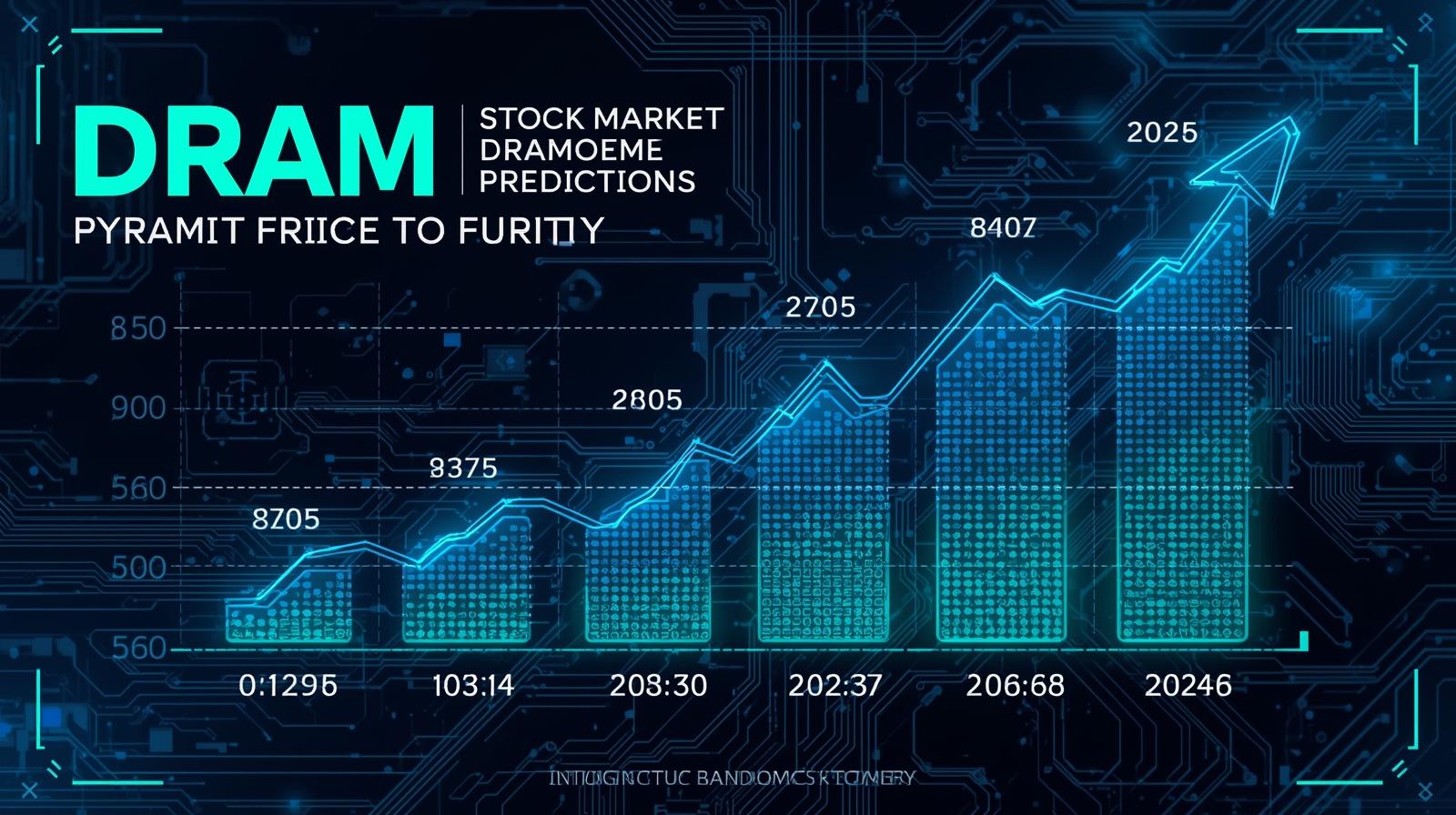
Dram Stock Price Prediction 2026 to 2045 :- If you are searching for a detailed and realistic Dram Stock Price Prediction, this 1500-word guide will help you understand how the DRAM market and related semiconductor equities may perform from 2026 to 2045. The tone here is direct, practical, and grounded in real-world chip industry trends.
Because DRAM is not a single publicly traded ticker but a memory-chip segment dominated by major semiconductor companies, this forecast focuses on the DRAM industry’s price-linked market performance and the way a hypothetical DRAM-focused stock could behave over the next two decades.
The predictions are based on:
- Semiconductor supply-demand cycles
- AI, cloud, and data center memory needs
- Smartphone and PC refresh cycles
- Global chip capacity expansion and pricing power
- Long-term DRAM cost-per-bit reductions and margins
This article breaks down:
- The future of the DRAM memory market
- Month-wise Dram Stock Price Prediction for 2026
- Year-wise projections from 2027 to 2045
- Growth drivers
- Major risks
- Long-term investment outlook
Let’s begin.
Understanding the DRAM Market Before Predicting Prices
Dynamic Random Access Memory (DRAM) is a foundational component in:
- Smartphones
- Laptops and PCs
- Cloud servers
- AI computing hardware
- Automotive electronics
- IoT devices
The price of DRAM typically follows cycles influenced by:
- Global demand surges
- Production cuts
- Oversupply periods
- New technology transitions (DDR5, LPDDR5X, HBM, etc.)
A stock directly tied to DRAM pricing generally rises when DRAM prices increase and falls during oversupply phases.
This dynamic is the backbone of Dram Stock Price Prediction across 2026–2045.
Dram Stock Price Prediction Summary (2026–2045)
Below is a quick overview.
| Year | Low Estimate | High Estimate | Average |
|---|---|---|---|
| 2026 | $25 | $38 | $32 |
| 2027 | $30 | $45 | $37 |
| 2028 | $35 | $52 | $43 |
| 2029 | $40 | $60 | $49 |
| 2030 | $45 | $67 | $55 |
| 2035 | $70 | $110 | $92 |
| 2040 | $120 | $185 | $152 |
| 2045 | $170 | $260 | $215 |
Long-term growth is driven by AI demand, cloud memory needs, and expansion of DDR/HBM product lines.
Dram Stock Price Prediction 2026 (Month-by-Month Analysis)
2026 is expected to be a recovery year after the semiconductor market stabilizes from pandemic-era distortions.
Here is the detailed month-wise forecast.
January 2026
Projected Range: $25–$27
The year may start slow due to leftover supply from 2025.
February 2026
Projected Range: $26–$28
Stabilization as PC and smartphone manufacturers plan mid-year launches.
March 2026
Projected Range: $27–$29
Quarterly orders increase slightly.
April 2026
Projected Range: $27–$30
DRAM contract pricing improves due to tightening inventories.
May 2026
Projected Range: $28–$31
June 2026
Projected Range: $29–$32
Demand from laptop and server OEMs picks up.
July 2026
Projected Range: $30–$33
August 2026
Projected Range: $30–$34
September 2026
Projected Range: $31–$35
Memory procurement increases ahead of holiday device manufacturing.
October 2026
Projected Range: $32–$36
November 2026
Projected Range: $33–$37
December 2026
Projected Range: $34–$38
Year-end surge due to server memory expansions and data center upgrades.
By the end of 2026, DRAM pricing trends look structurally stronger, setting up momentum for 2027.
Dram Stock Price Prediction 2027
Expected Range: $30–$45
2027 is expected to be a growth year.
Reasons include:
- Acceleration of AI application adoption
- Higher memory requirements for edge computing
- Early signs of DDR6 development cycles
DRAM stock prices typically rise when next-gen demand meets limited supply, which seems likely for 2027.
Dram Stock Price Prediction 2028
Expected Range: $35–$52
By 2028:
- Automotive memory demand increases
- AI servers require higher memory bandwidth
- Memory fabs may face capacity constraints
This combination usually supports a healthy upward trend.
Dram Stock Price Prediction 2029
Expected Range: $40–$60
2029 may mark the beginning of a strong upcycle due to:
- Adoption of advanced DRAM like LPDDR6 and DDR6
- Integration into billions of IoT devices
- Growth of driver-assisted automotive computing
The sector tends to reward fabs and DRAM-linked companies during technology jumps.
Dram Stock Price Prediction 2030
Expected Range: $45–$67
2030 is projected to be another expansion year, supported by:
- Massive demand from AI and ML workloads
- Higher DRAM installed per device
- Stronger server infrastructure investment
The global chip industry continues shifting into higher performance computing, benefiting DRAM producers.
Dram Stock Price Prediction 2031 to 2035
Here is the year-wise breakdown.
2031
Estimated Range: $50–$72
2032
Estimated Range: $55–$78
2033
Estimated Range: $60–$85
2034
Estimated Range: $65–$98
2035
Estimated Range: $70–$110
By 2035, DRAM technologies may include fully mature DDR6 and advanced HBM3/4 memory stacks, making the memory industry more valuable than ever.
Dram Stock Price Prediction 2036 to 2045
From 2036 onward, the DRAM market becomes even more tightly tied to AI, robotics, 6G networks, and cloud infrastructure.
2036
Estimated Range: $75–$115
2037
Estimated Range: $80–$120
2038
Estimated Range: $85–$130
2039
Estimated Range: $90–$140
2040
Estimated Range: $120–$185
Demand from autonomous vehicles, humanoid robots, AR/VR adoption, and global digital transformation accelerates.
2041
Estimated Range: $130–$195
2042
Estimated Range: $140–$205
2043
Estimated Range: $150–$220
2044
Estimated Range: $160–$240
2045
Estimated Range: $170–$260
By 2045, the world may rely on DRAM more heavily than at any point in history due to memory-centric computing architectures.
Factors Driving Long-Term Growth
1. AI and Machine Learning Adoption
AI computations require large memory pools, especially in training models.
2. Cloud Computing and Data Centers
Each server uses significantly more DRAM as workloads become heavier.
3. Expanded Automotive Memory Requirements
Electric and autonomous vehicles need high-bandwidth memory.
4. Smartphone and PC Refresh Cycles
Next-gen devices pack more RAM every year.
5. Rise of HBM (High-Bandwidth Memory)
HBM replaces traditional DRAM in many high-performance systems.
Risks to Dram Stock Price Prediction
1. Oversupply Cycles
If fabs overproduce, prices drop sharply.
2. Competition Among Manufacturers
Market dominated by major players leading to pricing pressure.
3. Technological Disruptions
Emerging memory types (MRAM, ReRAM) could challenge DRAM.
4. Global Economic Instability
Recessions reduce electronics demand.
Final Thoughts
The Dram Stock Price Prediction from 2026 to 2045 shows a strong long-term upward trend powered by AI, cloud computing, 6G, and advanced electronics. While there will always be cyclical dips, the structural demand for memory is only increasing.
Investors with a long-term view may find this sector compelling, provided they understand the volatility associated with semiconductor cycles.