
Dow jones Industrial Average Share Price 2025 to 2030:- The Dow Jones Industrial Average (DJIA), often simply referred to as the Dow Jones Industrial, is one of the world’s most closely watched stock market indices. Representing 30 of the largest publicly traded companies in the United States, the Dow is often seen as a barometer of U.S. economic health and investor sentiment.
From Wall Street traders to long-term investors, everyone keeps an eye on the Dow Jones Industrial because its movement signals the overall market direction. But as we move into the mid-2020s, investors are asking: What’s next for the Dow Jones Industrial share price between 2025 and 2030?
Let’s dive deep into its historical performance, economic factors, expert forecasts, and long-term growth prospects.
1. Understanding the Dow Jones Industrial Average
The Dow Jones Industrial is an index created in 1896 by Charles Dow and Edward Jones. It tracks 30 blue-chip companies that represent key sectors of the U.S. economy — including technology, finance, healthcare, manufacturing, and consumer goods.
Key Features:
- Comprises 30 leading companies such as Apple, Microsoft, Boeing, and Johnson & Johnson.
- Price-weighted index, meaning stocks with higher prices have more influence.
- Reflects overall U.S. market sentiment, often moving in tandem with broader economic cycles.
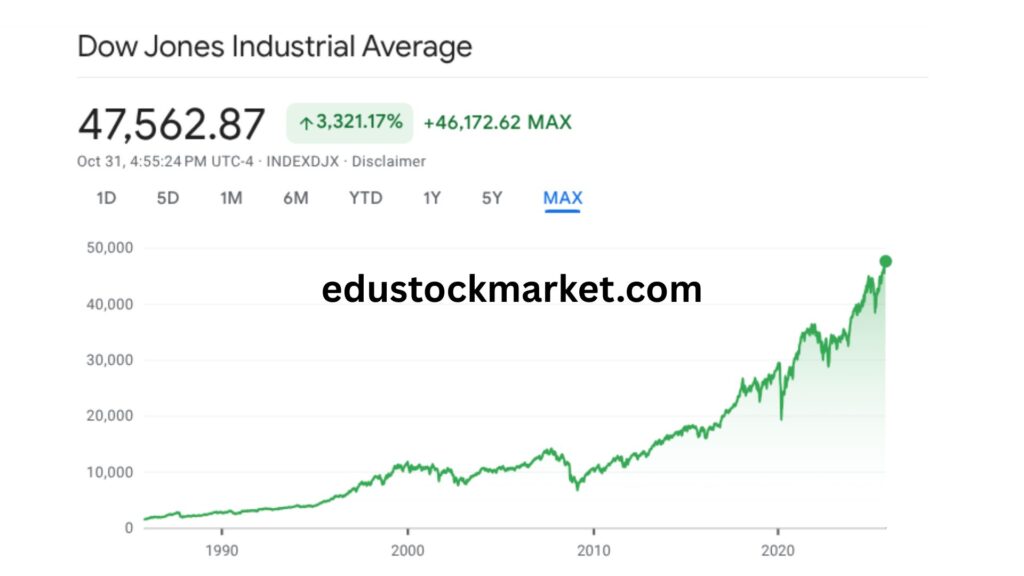
As of late 2024, the Dow Jones Industrial has shown strong resilience despite global inflation, interest rate hikes, and geopolitical tensions.
2. Historical Overview: Dow Jones Industrial Performance (2015–2024)
To understand the future of the Dow Jones Industrial, it’s important to look at its recent performance.
| Year | Average Index Level | Key Events |
|---|---|---|
| 2015 | 17,500 | Oil price slump and China’s slowdown |
| 2018 | 24,000 | Trade war tensions and Fed rate hikes |
| 2020 | 19,000 (March low) → 30,000 (year-end) | COVID-19 crash and recovery |
| 2021 | 34,000 | Stimulus-led bull run |
| 2023 | 33,500 | Inflation and interest rate pressures |
| 2024 | 38,000+ | AI-driven tech surge and stable growth |
The Dow’s resilience shows its ability to recover from global crises — supported by strong corporate earnings and innovation.
3. Key Factors Influencing the Dow Jones Industrial Outlook
Several economic and corporate factors will shape the Dow Jones Industrial share price between 2025 and 2030.
a. Federal Reserve Policies
Interest rate decisions from the Federal Reserve will be one of the biggest influences. Lower rates tend to boost equities, while higher rates can slow growth.
b. Inflation Trends
If inflation continues to moderate, investor confidence will rise — potentially pushing the Dow Jones Industrial to new highs.
c. Corporate Earnings Growth
Blue-chip companies like Apple, Microsoft, and Goldman Sachs are core to the Dow. Their earnings directly impact the index’s momentum.
d. Technological Advancements
AI, clean energy, and automation could fuel the next big rally in Dow components, especially in sectors like semiconductors, renewable energy, and data infrastructure.
e. Global Geopolitics
Trade relations between the U.S. and major partners like China and the EU could influence industrial output and corporate profitability.
4. Dow Jones Industrial Forecast 2025 to 2030
Let’s take a closer look at how the Dow Jones Industrial might perform year by year, based on current economic indicators, expert analysis, and historical patterns.
Dow Jones Industrial Prediction for 2025
By 2025, analysts expect the market to stabilize after years of inflation and rate adjustments. Corporate earnings could strengthen, especially in technology and financial sectors.
- Expected Range: 42,000 – 45,000
- Drivers: AI expansion, moderate interest rates, improved consumer confidence
Dow Jones Industrial Prediction for 2026
In 2026, U.S. GDP growth is expected to remain steady, with inflation under control. Energy and industrial stocks may lead the rally.
- Expected Range: 46,000 – 49,000
- Drivers: Manufacturing revival, strong labor market, and AI adoption
Dow Jones Industrial Prediction for 2027
Mid-decade could mark a new high for the Dow Jones Industrial, as companies benefit from cost-cutting technologies and steady global trade.
- Expected Range: 50,000 – 54,000
- Drivers: Corporate efficiency, global demand recovery, infrastructure spending
Dow Jones Industrial Prediction for 2028
By 2028, market volatility might increase due to election cycles and economic transitions. However, long-term investors could still see positive returns.
- Expected Range: 52,000 – 56,000
- Drivers: Political stability, continued digital transformation, expansion of industrial output
Dow Jones Industrial Prediction for 2029
As more sectors embrace green energy and AI, the Dow Jones Industrial could experience another strong upward move.
- Expected Range: 55,000 – 59,000
- Drivers: ESG investment boom, sustainable growth, and energy innovation
Dow Jones Industrial Prediction for 2030
By 2030, the Dow may surpass the 60,000 mark, driven by long-term growth, high-tech innovation, and strong dividend-paying companies.
- Expected Range: 58,000 – 62,000
- Drivers: AI maturity, energy diversification, and rising investor participation
5. Sectors to Watch Within the Dow Jones Industrial
Certain sectors within the Dow Jones Industrial could outperform others in the coming decade.
a. Technology
Companies like Apple, Microsoft, and Intel are driving digital transformation. AI, cloud computing, and data analytics will continue to push valuations higher.
b. Financial Services
Banks like JPMorgan Chase and Goldman Sachs are expected to benefit from digital banking growth and global capital inflows.
c. Healthcare
Healthcare giants like Johnson & Johnson and Amgen are expanding through innovation in biotech and pharmaceuticals.
d. Industrials
Companies like Boeing and Caterpillar will likely recover as infrastructure and defense spending rise.
e. Energy
ExxonMobil and Chevron could see steady returns as they transition into green energy and hydrogen projects.
6. Investment Strategy: How to Approach the Dow Jones Industrial
If you’re considering investing in the Dow Jones Industrial, here are a few smart strategies to consider:
1. Index ETFs
Invest through ETFs like SPDR Dow Jones Industrial Average ETF (DIA) to get diversified exposure to all 30 companies.
2. Dividend Reinvestment
Many Dow stocks pay reliable dividends. Reinvesting them can compound returns over time.
3. Dollar-Cost Averaging
Instead of timing the market, invest a fixed amount regularly. This approach reduces risk from short-term volatility.
4. Long-Term Holding
The Dow Jones Industrial has always rewarded patience. Long-term investors benefit from compounding, dividends, and capital appreciation.
7. Risks to Consider
No investment is without risk. While the Dow Jones Industrial is relatively stable, the following factors could create headwinds:
- Economic Recession: A slowdown could hit industrial and financial sectors.
- High Interest Rates: Could limit corporate borrowing and expansion.
- Global Uncertainty: Trade wars or geopolitical tensions might reduce investor confidence.
- Technological Disruption: Some traditional companies may struggle to adapt to innovation trends.
8. Long-Term Outlook Beyond 2030
Looking beyond 2030, the Dow Jones Industrial could remain one of the most reliable indicators of global financial health. If historical trends continue, investors might see the Dow reaching 70,000 by 2035 — marking steady, inflation-adjusted growth in the world’s strongest economy.
While short-term dips will occur, long-term fundamentals remain solid due to:
- Robust corporate innovation
- Sustainable energy transformation
- Continued technological progress
Conclusion
The Dow Jones Industrial remains a cornerstone of global markets — a reflection of America’s economic might and corporate strength. Between 2025 and 2030, it’s expected to show consistent growth fueled by technology, infrastructure development, and strong corporate earnings.
For long-term investors, the Dow Jones Industrial offers stability, steady returns, and diversification across multiple sectors. While short-term volatility is inevitable, the index’s century-long history proves one thing: patience pays off.
By 2030, the Dow Jones Industrial share price could cross the 60,000 mark, representing a new era of market expansion and investor confidence.
Frequently Asked Questions (FAQs)
1. What is the Dow Jones Industrial Average?
The Dow Jones Industrial is a price-weighted index tracking 30 of the largest publicly traded U.S. companies. It represents the overall performance of the U.S. stock market.
2. How is the Dow Jones Industrial calculated?
It’s calculated using a price-weighted formula — meaning higher-priced stocks like Apple or Microsoft have a greater impact on the index’s movement.
3. What is the current level of the Dow Jones Industrial?
As of late 2024, the Dow Jones Industrial trades around 38,000 points, marking steady growth since the 2020 pandemic.
4. Will the Dow Jones Industrial reach 50,000 by 2030?
Yes, many analysts predict the Dow Jones Industrial could reach or surpass 50,000–60,000 by 2030, depending on inflation, interest rates, and economic stability.
5. Is the Dow Jones Industrial a good long-term investment?
Yes. Historically, the Dow Jones Industrial has provided stable long-term returns, making it a preferred index for conservative and institutional investors.
6. Which companies are included in the Dow Jones Industrial?
Major names include Apple, Microsoft, Boeing, Coca-Cola, Johnson & Johnson, Goldman Sachs, and McDonald’s — representing diverse sectors of the economy.
7. How can I invest in the Dow Jones Industrial?
You can invest directly through ETFs like DIA (SPDR Dow Jones Industrial Average ETF) or through mutual funds that track the index.
8. What are the risks of investing in the Dow Jones Industrial?
Risks include market downturns, interest rate hikes, and global economic uncertainty. However, diversification helps reduce these risks.