

Intel Stock Price Prediction 2025 to 2035:- Intel has long been one of the most recognizable names in the semiconductor industry. Once the undisputed leader in computer processors, the company has faced fierce competition from AMD, Nvidia, and TSMC in recent years. However, Intel’s renewed focus on manufacturing, AI chips, and foundry services has many investors wondering: where is the intel stock price headed between 2025 and 2035?
This comprehensive forecast examines Intel’s financial health, growth potential, and external challenges to estimate how its stock could evolve over the next decade.
Overview of Intel’s Position
Intel (NASDAQ: INTC) remains one of the largest semiconductor companies globally, producing processors, GPUs, and now advanced foundry services for other chipmakers. After years of lagging behind competitors technologically, Intel is executing an ambitious turnaround plan led by CEO Pat Gelsinger, focused on:
- Manufacturing Comeback: Building new fabrication plants in the U.S. and Europe to regain process leadership.
- Foundry Services Expansion: Competing directly with TSMC and Samsung as a contract chip manufacturer.
- AI and Data Center Growth: Launching next-generation AI chips to challenge Nvidia’s dominance.
- Cost Efficiency: Streamlining operations to improve margins and strengthen free cash flow.
These initiatives are critical in determining the trajectory of the intel stock price from 2025 to 2035.
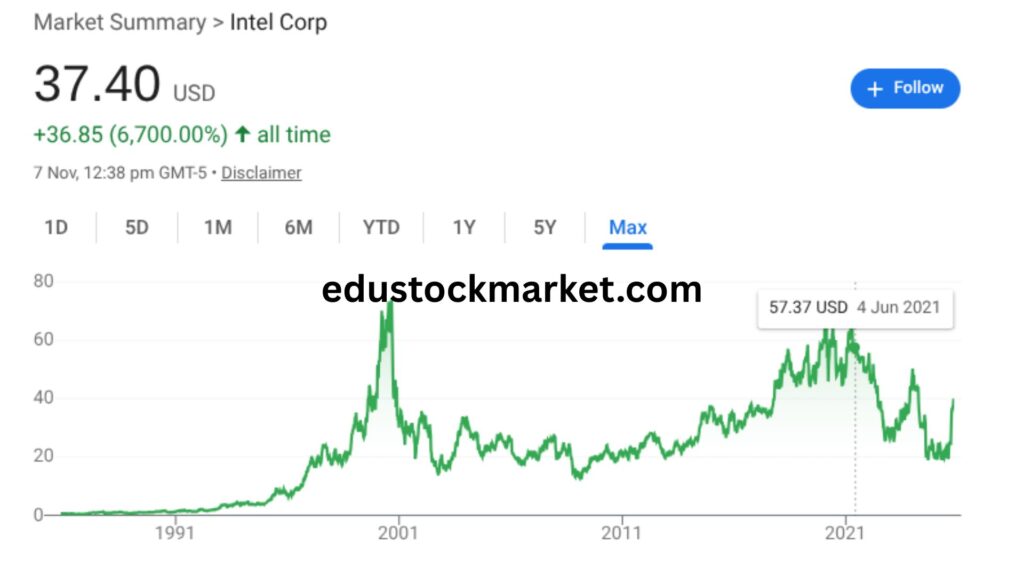
Intel’s Financial Snapshot (as of 2025)
- Revenue: Around $55–$60 billion annually (slightly recovering after post-pandemic softness).
- Market Cap: Roughly $150–$170 billion.
- P/E Ratio: Around 25–30x, depending on earnings revisions.
- Dividend Yield: 1%–2%, with gradual dividend growth expected as profits stabilize.
- Debt: Moderate, but balanced by significant infrastructure investment for fabs.
Intel’s near-term performance remains tied to its ability to regain chip leadership and execute on manufacturing milestones.
Intel Stock Price Forecast: 2025 to 2035
Year 2025 — Stabilization Phase
After years of restructuring, 2025 will likely be a year of balance. Intel’s new fabs in Arizona and Ohio begin ramping production, but margins may stay tight due to large capital expenditures.
- Estimated intel stock price (2025): $42 – $55
- Catalysts: Early foundry customer wins, AI chip shipments, and improving investor sentiment.
- Risks: Execution delays and competition from AMD and Nvidia.
Year 2026 — Signs of Growth
If Intel’s manufacturing roadmap (Intel 18A and beyond) stays on track, the market could begin revaluing the company as a foundry and AI chip contender.
- Estimated intel stock price (2026): $50 – $65
- Growth drivers: Data center recovery and AI accelerator demand.
- Bear case: Weak demand or slower yield ramp in new fabs.
Year 2027 — Expansion & AI Acceleration
Intel’s advanced manufacturing nodes could start competing effectively with TSMC, positioning it for major client wins. The company could also scale AI chip production and expand into custom silicon.
- Estimated intel stock price (2027): $60 – $75
- Highlights: Foundry revenue recognition and higher-margin AI solutions.
Year 2028 — Foundry Momentum Builds
By this stage, Intel’s foundry division could contribute significantly to revenue. The U.S. CHIPS Act and government contracts might also bolster cash flows.
- Estimated intel stock price (2028): $70 – $85
- Upside scenario: Intel becomes a strategic U.S.-based alternative to TSMC for high-end chips.
Year 2029 — Profitability Rebound
With strong utilization of fabs and improved efficiency, Intel’s operating margins could rebound. AI, automotive, and IoT chips may represent larger parts of revenue.
- Estimated intel stock price (2029): $80 – $95
- Key factor: Sustained double-digit EPS growth.
Year 2030 — Leadership Reestablished
By 2030, Intel may achieve technological parity or leadership in select chip segments. If global demand for AI, 5G, and edge computing grows as expected, Intel could benefit from both supply and design wins.
- Estimated intel stock price (2030): $90 – $120
- Bull case: Strong execution, market share recovery, and high demand for AI chips.
- Bear case: Global chip oversupply or margin erosion.
Year 2031–2032 — Maturity and Diversification
Intel could evolve into a diversified chip powerhouse offering CPUs, GPUs, AI accelerators, and foundry services at scale. Profitability may stabilize, and dividend growth could attract income investors.
- Estimated intel stock price (2031–2032): $110 – $135
- Catalyst: Consistent free cash flow generation and balanced capital allocation.
Year 2033–2035 — Long-Term Potential
If Intel successfully executes its decade-long roadmap, the intel stock price could experience substantial revaluation. Market leadership in AI semiconductors, quantum computing, or government-backed chip initiatives could unlock further upside.
- Estimated intel stock price (2033–2035): $130 – $180
- Long-term upside: High-margin foundry services and technology licensing.
- Downside risks: Technological stagnation or global recession.
Key Growth Drivers for Intel
- AI and Machine Learning Chips
Intel’s Gaudi and Falcon Shores architectures aim to capture part of the booming AI accelerator market. If adoption accelerates, Intel could meaningfully diversify away from PC dependency. - Intel Foundry Services (IFS)
This division could become Intel’s crown jewel by 2030. Winning external clients—especially U.S. government and hyperscale partners—would ensure steady demand. - Geopolitical Tailwinds
Western governments are pushing for semiconductor independence from Asia. Intel’s U.S. and European fabs position it perfectly for such policy incentives. - Emerging Market Demand
Expanding internet penetration, EV growth, and AI adoption in emerging markets could lift global chip demand, directly benefiting Intel’s total addressable market. - Technological Roadmap Execution
Intel’s process nodes (Intel 3, 20A, 18A) and packaging innovations (Foveros, EMIB) could restore its technical credibility if timelines hold.
Key Risks to Watch
- Execution Delays
Intel’s turnaround hinges on flawless execution. Any delay in new node development could erode investor confidence. - Competition Pressure
AMD, Nvidia, and TSMC remain strong competitors. Intel must innovate faster and maintain cost efficiency to stay relevant. - Capital Intensity
Massive fab investments could strain free cash flow if returns take longer than expected. - Macroeconomic Slowdowns
Global recessions or weak consumer PC demand can pressure earnings and the intel stock price in the near term. - Geopolitical Tensions
Trade restrictions or international conflicts may impact supply chains and sourcing of critical materials.
Valuation Outlook
Assuming steady revenue growth (6–8% CAGR) and operating margin expansion over the next decade, Intel’s EPS could grow at roughly 10–12% annually. Using historical valuation multiples (15x–20x forward P/E), the projected intel stock price range for 2030–2035 aligns with $120–$180 in the base-to-bull scenario.
If Intel’s foundry and AI divisions outperform, the market could assign a premium multiple—similar to Nvidia’s today—pushing the stock even higher. Conversely, if execution falters, shares could remain stuck below $80 for several years.
Analyst Opinions (as of 2025)
Most Wall Street analysts maintain a “Hold to Moderate Buy” rating on Intel. The consensus 12-month price target lies between $50–$60, reflecting cautious optimism about early foundry success and improving demand for AI chips.
Longer-term analysts forecast a steady upward trend through the early 2030s as Intel reclaims market relevance. However, skepticism remains about Intel’s ability to match TSMC’s process leadership.
Investment Perspective
Intel represents a classic “turnaround with upside” story. Investors looking for short-term explosive growth might prefer Nvidia or AMD, but those seeking long-term value exposure to the semiconductor supply chain could find Intel attractive at current valuations.
Why consider Intel for the long term:
- Diversified exposure to AI, data centers, and foundries.
- Strong government and institutional support.
- Potential multiple re-rating if execution succeeds.
Why be cautious:
- Heavy capital spending and uncertain payback period.
- Lagging innovation could cap market share recovery.
- The semiconductor cycle remains inherently volatile.
A balanced approach—accumulating shares gradually while monitoring quarterly execution—may be the best strategy.
Frequently Asked Questions (FAQ)
Q1: What will be Intel’s stock price in 2025?
A: The intel stock price in 2025 is expected to range between $42–$55, reflecting ongoing recovery and early foundry results.
Q2: Can Intel regain its technological leadership?
A: Possibly by 2030. If Intel meets its process-node goals and secures foundry clients, it could reach parity with TSMC in select areas.
Q3: Is Intel a good long-term investment?
A: Yes, for patient investors. Intel’s turnaround is a multi-year process, but its role in national chip independence and AI computing gives it strong strategic value.
Q4: What could push the intel stock price higher by 2035?
A: Consistent foundry success, AI chip growth, and margin expansion from new technologies could lift the intel stock price toward $150–$180.
Q5: What are the main risks?
A: Execution failures, competitive losses to AMD/Nvidia, and global macroeconomic slowdowns are key risks that could limit gains.
Final Thoughts
The intel stock price over the next decade will depend largely on execution, technology leadership, and capital efficiency. Intel is no longer just a PC chip company—it’s positioning itself as a global foundry and AI powerhouse.
If Intel delivers on its promises, it could regain relevance and generate substantial shareholder returns by 2035. But if it stumbles on manufacturing or innovation, it risks staying in the shadow of faster-moving rivals.
For long-term investors willing to ride the volatility, Intel remains a compelling—but challenging—comeback story in the semiconductor world.