

The U.S. housing market has always been a hotbed for innovation, and Opendoor Technologies Inc. (NASDAQ: OPEN) has been at the center of a radical shift. Known for pioneering the iBuying model—where homeowners can instantly sell their homes online—Opendoor has attracted both excitement and skepticism from Wall Street.
The real question for investors today is: where is Opendoor stock headed between 2025 and 2035?
This blog dives deep into the company’s business model, financials, market dynamics, risks, and long-term predictions. By the end, you’ll have a clearer view of what Opendoor stock might look like over the next decade.
Understanding Opendoor
What Does Opendoor Do?
- Opendoor uses technology and data analytics to buy, renovate, and sell homes.
- Homeowners benefit from speed and certainty compared to traditional listings.
- Revenue primarily comes from home resales, service fees, and financing products.
Why Opendoor Matters
- The U.S. housing market is worth over $2 trillion annually.
- Even capturing a small percentage can make Opendoor a massive business.
- It represents the intersection of technology, real estate, and fintech.
Current Position of Opendoor Stock (2024–2025 Context)
Before looking forward, it’s essential to see where things stand now.
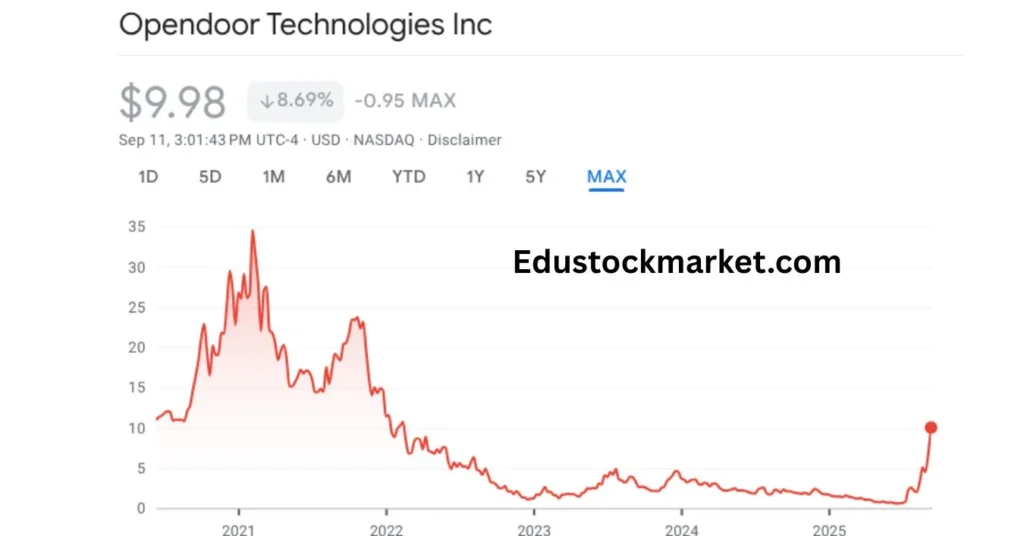
- Stock Price Performance: After going public via SPAC in 2020, Opendoor stock soared initially but later declined sharply due to housing market slowdowns and interest rate hikes. By late 2024, shares were trading in the $2–$4 range, far below early highs.
- Revenue: Peaked at nearly $15 billion in 2022, but slowed as housing cooled.
- Profitability: Still struggling with consistent profitability. Losses remain a challenge due to high carrying costs and fluctuating home prices.
- Competition: Faces rivals like Zillow (which exited iBuying), Offerpad, and traditional brokers adapting to digital platforms.
This makes 2025 a potential turning point—if interest rates decline and housing activity rebounds, Opendoor stock could see meaningful momentum.
Key Factors That Will Influence Opendoor Stock
1. Housing Market Conditions
- Lower mortgage rates would stimulate demand and boost transaction volumes.
- Rising home prices benefit Opendoor’s resale margins.
- A downturn could quickly cut profitability.
2. Interest Rates
- The Federal Reserve’s policy is critical.
- Lower borrowing costs help Opendoor finance its housing inventory more efficiently.
3. Technology & Data Advantage
- Advanced algorithms in pricing give Opendoor an edge.
- Accuracy in valuation reduces risks of overpaying for homes.
4. Profitability & Cash Flow
- Investors will demand consistent positive cash flow by late 2020s.
- Without this, Opendoor stock could remain stuck at penny-stock levels.
5. Expansion Opportunities
- New markets in U.S. cities.
- Potential global expansion (though risky).
- Add-on services like mortgage, title, and insurance.
Opendoor Stock Prediction 2025 to 2035
Methodology for Forecasting
- We’ll use three scenarios: Bear, Base, and Bull.
- Factors considered: housing demand, interest rates, execution, and tech adoption.
- Predictions are ranges, not guarantees.
2025–2026: The Recovery Phase
- Bear Case: If mortgage rates stay high and home sales remain sluggish, Opendoor stock could hover around $2–$4.
- Base Case: With moderate housing recovery, shares may climb into the $6–$8 range.
- Bull Case: If interest rates drop sharply and transactions rise, Opendoor stock could surge toward $10–$12.
Key Watchpoints: Housing affordability, Fed rate policy, and Opendoor’s cost control.
2027–2029: Scaling Up or Stalling Out
By late 2020s, Opendoor must prove it’s more than a housing-cycle play.
- Bear Case: If profitability remains elusive, stock may languish at $3–$5.
- Base Case: Steady revenue growth and breakeven profits could lift shares to $12–$18.
- Bull Case: Full profitability, strong U.S. presence, and expansion of services could push Opendoor stock to $20–$25.
Key Watchpoints: Margins, revenue mix (ancillary services), and debt management.
2030–2032: Market Leadership or Market Exit
This period will define whether Opendoor becomes the Amazon of housing or a failed experiment.
- Bear Case: Rising competition and weak execution could sink shares back to $1–$3, risking delisting.
- Base Case: By now, sustained profitability could support a stock price of $20–$30.
- Bull Case: If Opendoor dominates digital real estate, shares could soar to $40–$50.
Key Watchpoints: U.S. market share, global expansion, and AI-powered valuation accuracy.
2033–2035: Maturity or Transformation
By mid-2030s, Opendoor will either be a major real estate platform or absorbed by a larger player.
- Bear Case: Limited adoption keeps stock between $5–$8.
- Base Case: Stable business model, consistent profits, and dividends could value shares at $30–$40.
- Bull Case: If Opendoor becomes the go-to platform for housing transactions, stock might hit $60–$80.
Key Watchpoints: Investor trust, brand dominance, and regulatory hurdles.
Summary Table: Opendoor Stock Prediction 2025–2035
| Year | Bear Case | Base Case | Bull Case |
|---|---|---|---|
| 2025 | $2–$4 | $6–$8 | $10–$12 |
| 2026 | $3–$5 | $7–$9 | $12–$14 |
| 2027 | $3–$5 | $10–$14 | $15–$20 |
| 2028 | $3–$5 | $12–$16 | $18–$22 |
| 2029 | $3–$5 | $14–$18 | $20–$25 |
| 2030 | $1–$3 | $18–$25 | $30–$40 |
| 2031 | $2–$4 | $20–$28 | $35–$45 |
| 2032 | $2–$4 | $22–$30 | $40–$50 |
| 2033 | $5–$7 | $25–$35 | $45–$60 |
| 2034 | $5–$8 | $28–$38 | $55–$70 |
| 2035 | $5–$8 | $30–$40 | $60–$80 |
Risks Facing Opendoor Stock
- Housing Market Cyclicality: A severe recession or housing crash could wipe out profits.
- Regulation: Stricter lending and housing rules may impact the model.
- Competition: Traditional brokers, Zillow-like platforms, and new entrants.
- Profitability Struggles: Long-term survival depends on consistent margins.
Opportunities for Opendoor
- Digital Transformation: Younger generations prefer online transactions.
- Data & AI: Improving home valuation accuracy reduces risks.
- Service Expansion: Mortgages, insurance, and renovation add revenue streams.
- Potential Buyout: Larger fintech or real estate companies could acquire Opendoor.
Conclusion
The next decade will be make-or-break for Opendoor stock. In the short term (2025–2026), performance will hinge on interest rates and housing demand. By the late 2020s, investors will want proof of profitability and resilience across cycles.
By 2035, Opendoor stock could either be trading at $60–$80 in a bull case—or stuck below $10 if the business model doesn’t scale.
For investors, the lesson is clear: this is a high-risk, high-reward stock. Those who believe in technology transforming real estate may see huge upside, but caution and position sizing are essential.
Trending FAQs on Opendoor Stock
Q1. What is Opendoor’s business model?
Opendoor buys homes directly from sellers, renovates them, and resells while charging service fees.
Q2. Is Opendoor profitable yet?
Not consistently. It has shown revenue growth but continues to post net losses.
Q3. Why is Opendoor stock so volatile?
Because it depends heavily on housing market cycles, interest rates, and investor sentiment.
Q4. What’s the Opendoor stock prediction for 2025?
Predicted range is $6–$8 base case, with upside to $12 if housing rebounds strongly.
Q5. Can Opendoor become the Amazon of housing?
Possibly. If it scales nationwide, expands into mortgages, and sustains profitability, it could dominate.
Q6. Could Opendoor go bankrupt?
Yes, in a severe housing downturn with high debt, bankruptcy is a risk—though not the base case.
Q7. Is Opendoor a good long-term investment?
It depends on your risk appetite. It offers high growth potential but comes with significant risks.