

Spy Stock Price Prediction 2025 to 2035:- If you’re watching the U.S. stock market closely, you’ve probably come across SPDR S&P 500 ETF Trust (SPY) — one of the most popular ETFs in the world. It mirrors the performance of the S&P 500, giving investors access to the largest 500 publicly traded U.S. companies.
Investors often check spy stock price to gauge how the entire market is doing, since it’s a direct reflection of American corporate performance. But what does the next decade hold? From 2025 to 2035, the U.S. economy is expected to undergo major transformations driven by technology, AI, interest rate cycles, and global trade shifts.
In this article, we’ll break down expert projections, key factors affecting SPY, and a year-by-year spy stock price prediction to help investors plan their strategies.
Understanding SPY and Its Role in the Market
Before diving into predictions, it’s important to understand what SPY represents. Spy Stock Price Prediction 2025 to 2035
- Ticker Symbol: SPY
- Launched: 1993 by State Street Global Advisors
- Tracks: S&P 500 Index (500 large-cap U.S. companies)
- Expense Ratio: Around 0.09%
- Dividend Yield: Roughly 1.3–1.6% (varies annually)
The spy stock price essentially reflects the weighted performance of companies like Apple, Microsoft, Amazon, Nvidia, and JPMorgan Chase. When these giants perform well, SPY climbs; when they stumble, SPY falls.
SPY Stock Price Today: The Current Market Setup
As of the latest data in 2025, the spy stock price hovers near the $530–$550 range, reflecting a strong bull run after inflation cooled and the Federal Reserve started cutting interest rates.
The rally has been powered by:
- Soaring tech stocks, especially in AI and semiconductor sectors.
- Improved corporate earnings.
- Soft landing expectations for the U.S. economy.
- Renewed retail and institutional participation.
This strong base gives a promising setup for the decade ahead — but let’s examine what factors could move SPY from here.
Key Factors Influencing SPY’s Future
1. Interest Rates and Inflation
SPY’s growth is tightly linked to Federal Reserve policy. When interest rates fall, borrowing becomes cheaper, helping businesses grow and consumers spend more — both positive for spy stock price.
However, if inflation spikes again and the Fed tightens policy, it could cause temporary pullbacks.
2. Corporate Earnings
The 500 companies in SPY drive its valuation. Long-term earnings growth of 6–8% annually could sustain strong upside.
Expect sectors like technology, clean energy, healthcare, and financial services to contribute most to growth between 2025 and 2035.
3. Technological Innovation
AI, automation, and semiconductor advances will continue to fuel productivity. Firms like Nvidia, Apple, and Microsoft will likely remain top drivers of SPY’s performance.
4. Global Economic Conditions
Recession fears, geopolitical risks (China–U.S. relations, oil supply shocks), and trade dynamics could affect global investor sentiment and the spy stock price in the short term.
5. Dollar Strength and Inflation Trends
A weakening dollar could make U.S. equities more attractive to foreign investors, potentially pushing SPY higher. On the flip side, sustained inflation might compress margins, slowing SPY’s advance.
Historical Performance: What the Past Tells Us
To project the future, it helps to understand history.
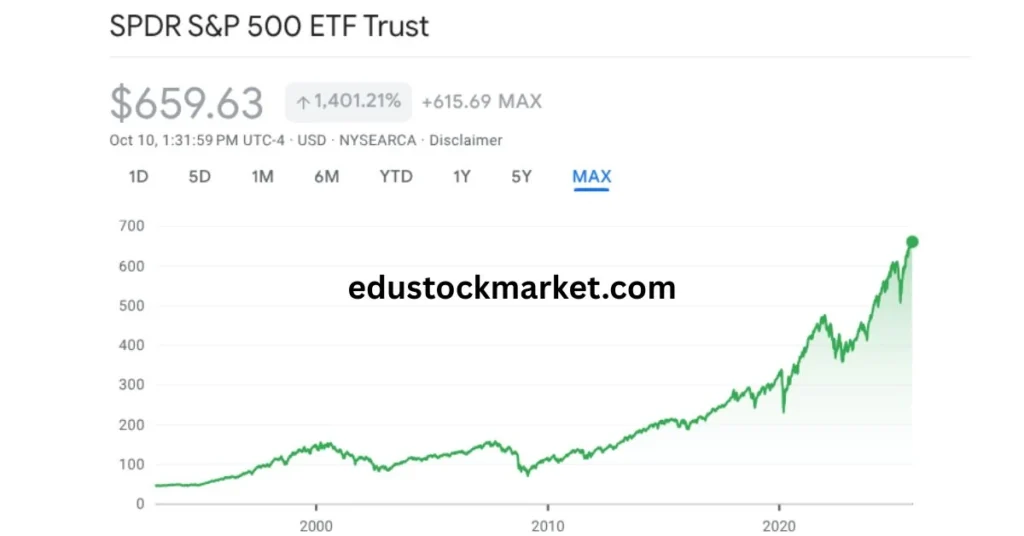
Over the past three decades, SPY has produced an average annual return of about 9–10% (including dividends).
Here’s how SPY performed in major decades:
- 1990s: ~17% annualized returns — tech boom era
- 2000s: ~-1% annualized — dot-com crash and financial crisis
- 2010s: ~13% annualized — post-recession recovery
- 2020s (so far): ~11–12% average — driven by AI, tech, and post-pandemic growth
If this trend continues, investors could see another decade of solid, though possibly slower, growth ahead.
SPY Stock Price Prediction 2025 to 2035
Below is a decade-long projection for SPY, outlining conservative, base, and bullish scenarios.
| Year | Conservative ($) | Base Case ($) | Bullish ($) | Key Assumptions |
|---|---|---|---|---|
| 2025 | 520–560 | 550–580 | 600+ | Fed begins rate cuts, stable earnings |
| 2026 | 530–590 | 580–640 | 680+ | Strong tech earnings, stable inflation |
| 2027 | 550–610 | 620–700 | 760 | AI-driven growth, improved productivity |
| 2028 | 570–650 | 680–760 | 850 | S&P earnings expand 7–9% annually |
| 2029 | 600–700 | 720–800 | 900+ | Economic stability, record profits |
| 2030 | 620–740 | 780–880 | 980 | AI & robotics dominate corporate margins |
| 2031 | 650–780 | 820–920 | 1,050 | Continued global expansion |
| 2032 | 680–820 | 860–980 | 1,150 | Higher dividends, sustainable inflation |
| 2033 | 710–860 | 900–1,050 | 1,200+ | Tech and energy sectors thrive |
| 2034 | 740–900 | 950–1,100 | 1,280 | Fed stabilizes rates, low unemployment |
| 2035 | 780–950 | 1,000–1,200 | 1,350–1,500 | Long bull cycle peaks before consolidation |
Base Case Summary
By 2035, SPY could reach $1,000–$1,200, assuming the S&P 500 compounds at an annual rate of around 7–8%. This implies a near doubling of today’s spy stock price over the decade.
SPY Sector Contributions (2025–2035)
- Technology (35–40%) – AI, cloud computing, and semiconductors will dominate. Nvidia, Microsoft, and Apple remain core drivers.
- Healthcare (13%) – Aging demographics and biotech innovation add consistent growth.
- Financials (12%) – As rates stabilize, banks and insurers could rebound.
- Energy (7%) – Transition to renewables may bring volatility but long-term opportunity.
- Consumer Discretionary (11%) – E-commerce and digital entertainment to stay strong.
This sector balance ensures spy stock price stability even during short-term volatility.
Why SPY Remains a Top Long-Term Investment
1. Diversification
SPY gives exposure to 500 leading companies — reducing the risk of single-stock losses.
2. Consistent Dividends
While SPY’s yield is modest, dividend growth compounds over time.
3. Historical Resilience
Despite recessions, pandemics, and wars, SPY has always recovered to hit new highs.
4. Liquidity and Accessibility
SPY is one of the most traded ETFs globally, offering instant liquidity for retail and institutional investors alike.
5. Inflation Hedge Over Time
Though not perfect, the spy stock price generally outpaces inflation over long horizons, protecting purchasing power.
Potential Risks for SPY Investors
Even the strongest ETFs face risks. Here’s what could derail SPY’s growth trajectory:
- Persistent Inflation: Could force the Fed to keep rates high longer, suppressing equity valuations.
- Tech Sector Overvaluation: A sharp correction in tech stocks could drag down SPY.
- Geopolitical Conflicts: Trade tensions or wars could spook investors.
- Debt and Fiscal Pressures: U.S. government debt and deficits could weigh on long-term confidence.
- Earnings Stagnation: Slower productivity or shrinking margins could cap returns.
Smart investors watch these risks to adjust positions before market turbulence hits.
Expert Opinions on SPY’s Future
- Goldman Sachs (2025): Predicts the S&P 500 could reach 6,200 by 2026, driven by strong AI-related earnings growth.
- Morningstar (2025): Expects 8% average annual total returns for SPY over the next decade.
- JP Morgan (2025): Notes SPY could outperform international equities if inflation remains stable and the Fed manages a soft landing.
- Bloomberg Analysts: Forecast SPY could double by 2035 if real GDP grows around 2% annually and earnings compound at 7%.
These projections align with our base-case scenario — a steady climb in spy stock price to near or above $1,100 by 2035.
Investment Strategy for the Next Decade
To maximize returns from SPY, investors can follow these approaches:
1. Dollar-Cost Averaging (DCA)
Invest a fixed amount every month regardless of price. Over time, it smooths out market volatility and builds long-term wealth.
2. Dividend Reinvestment
Reinvest SPY dividends automatically to compound returns faster.
3. Long-Term Holding
Avoid frequent trading. The biggest gains come from holding through cycles, not timing them.
4. Tactical Rebalancing
Adjust your allocation slightly during extreme market peaks or dips to protect profits and buy more units at discounts.
5. Stay Informed
Monitor interest rates, corporate earnings, and inflation data — these directly impact spy stock price trends.
FAQ
Q1. What is the current spy stock price?
As of 2025, the spy stock price trades between $530–$550, near record highs.
Q2. Is SPY a good long-term investment?
Yes. SPY historically delivers strong risk-adjusted returns due to diversification and exposure to the top-performing U.S. companies.
Q3. Can SPY reach $1,000 by 2035?
Based on 7–8% annualized growth, it’s very realistic for SPY to reach $1,000–$1,200 by 2035 in a base scenario.
Q4. Does SPY pay dividends?
Yes. SPY distributes quarterly dividends, yielding around 1.5%, which adds to total return.
Q5. What are the biggest risks for SPY investors?
Inflation, interest rate hikes, tech sector crashes, or global recessions could temporarily hurt spy stock price performance.
Q6. Should I buy SPY now or wait for a dip?
If you’re investing for 10+ years, starting now and using a DCA approach makes sense — timing the market rarely works.
Conclusion
The spy stock price today reflects more than just market optimism — it represents the resilience and innovation of American enterprise.
From 2025 to 2035, SPY is expected to remain a core wealth-building asset for investors worldwide. While short-term corrections will occur, the long-term trajectory points upward as corporate earnings, technological advances, and productivity gains expand the economy.
If history repeats — and it often does — SPY could easily double over the next decade. For patient investors who believe in the long-term strength of the U.S. market, SPY remains one of the smartest, simplest, and most reliable investments available today.