

Uber Stock Price Prediction 2025 to 2030:- Uber Technologies Inc. (NYSE: UBER) is no longer just a ride-hailing company. It’s a global technology platform spanning mobility, food delivery, freight logistics, and digital payments. As the company continues to expand across multiple sectors, investors are watching closely to see where the Uber stock price could head in the coming decade — especially as profitability, automation, and regulatory changes reshape the landscape.
This blog post provides a deep dive into Uber’s fundamentals, growth outlook, and projected stock price targets from 2025 to 2030, written in a direct, human tone. We’ll also end with a practical FAQ to help investors understand Uber’s future potential.
Introduction: Uber’s Transformation Story
When Uber went public in 2019, it was seen as a disruptive tech giant with sky-high growth ambitions but no profits. Fast forward to 2025 — Uber has transitioned into a profitable platform company with diversified income streams.
- Ride-hailing remains the core business, with over 130 million monthly active users.
- Uber Eats, the food delivery arm, contributes nearly 40% of total revenue.
- Uber Freight connects shippers and carriers, providing additional diversification.
- Autonomous technology partnerships and cost optimization are shaping the company’s future.
These changes have helped stabilize the uber stock price, which once swung wildly on market sentiment. Now, it’s increasingly seen as a maturing growth stock with sustainable earnings potential.
Uber’s Financial Snapshot (2024–2025)
Before forecasting, let’s look at where Uber stands as of 2025:
- Market Cap: Around $150 billion
- Revenue (TTM): ~$40 billion
- Operating Margin: Approaching 10%
- Free Cash Flow: Strong and improving, crossing the $5 billion mark
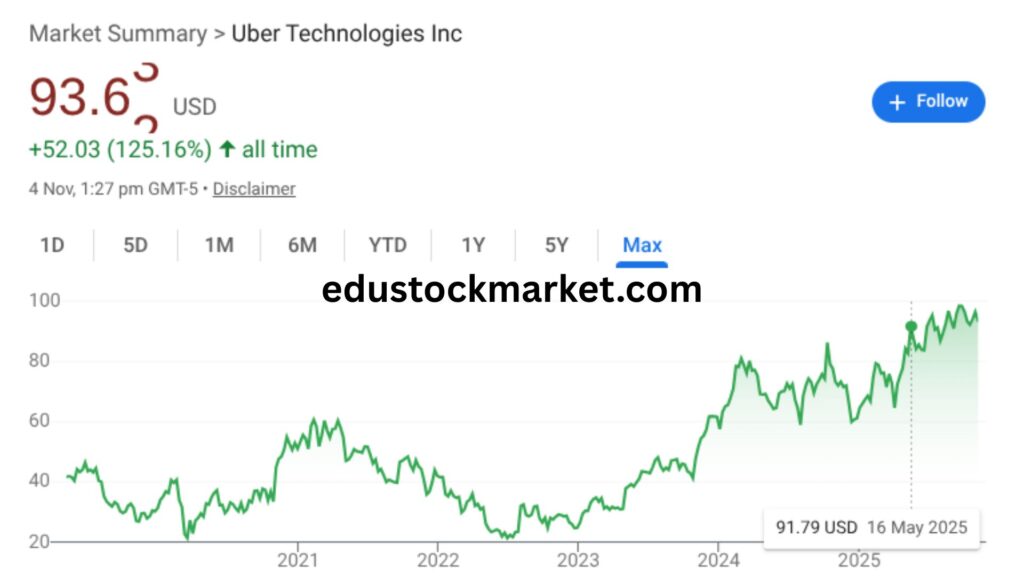
- Uber stock price today: Hovering near $70–$75 per share
After years of heavy investment and losses, Uber has achieved consistent profitability — a key reason analysts are revisiting long-term price targets.
Key Drivers Behind the Uber Stock Price
The uber stock price depends on multiple strategic and macro factors. Let’s break them down:
1. Profitability and Margins
Uber’s ability to sustain profitability is its most important catalyst. Cost reductions, better driver incentive structures, and AI-driven demand matching have improved margins across regions.
2. Global Expansion and Market Share
Uber continues to dominate markets in North America, Europe, and Latin America. Emerging markets like India and Southeast Asia remain large growth opportunities, especially as urbanization and smartphone penetration accelerate.
3. Uber Eats Growth
Uber Eats is a powerhouse that helped stabilize revenue during the pandemic and continues to drive topline growth. Cross-platform synergies (users ordering food and booking rides in one app) increase engagement and retention.
4. Uber Freight and Logistics
Freight digitization is gaining traction. Uber’s platform-based logistics network helps shippers connect with carriers more efficiently — a segment that could account for 10–15% of total revenues by 2030.
5. Technological Innovation
Uber’s partnerships in autonomous driving (with Waymo, Aurora, and Motional) may significantly cut costs over time. Similarly, AI integration enhances route optimization, pricing, and safety monitoring — all supporting a stronger uber stock price outlook.
6. Share Buybacks and Capital Allocation
Uber’s improving cash flow gives it flexibility to return capital to shareholders through buybacks, debt reduction, or strategic acquisitions — another positive driver for the uber stock price.
Risks That Could Impact Uber’s Future
Despite strong tailwinds, Uber faces a few critical risks investors should watch:
- Regulatory pressure: Governments worldwide continue to challenge Uber’s labor model. If drivers are reclassified as employees in major markets, costs could rise significantly.
- Competition: Lyft, Bolt, DiDi, and local ride-hailing startups still pressure margins in various regions.
- Economic downturn: Slower global spending or rising fuel prices could affect ride demand and delivery volumes.
- Technology execution risk: Delays in autonomous vehicle rollouts or software errors could slow future cost efficiencies.
- Legal and compliance issues: Uber’s global operations expose it to lawsuits, antitrust scrutiny, and data privacy regulations.
These risks don’t negate Uber’s potential but underline that the uber stock price will remain somewhat volatile, especially around earnings announcements or policy shifts.
Uber Stock Price Prediction (2025–2030)
Here’s a detailed projection of where analysts and models see the uber stock price heading through 2030 under three scenarios — conservative, base, and bullish.
Uber Stock Price Prediction 2025
- Conservative: $65
- Base Case: $75
- Bullish: $90
Uber maintains profitability but market sentiment remains cautious amid global macro uncertainty.
Uber Stock Price Prediction 2026
- Conservative: $70
- Base Case: $85
- Bullish: $105
Rising margins and improved brand trust push Uber higher; analysts start revising targets upward.
Uber Stock Price Prediction 2027
- Conservative: $80
- Base Case: $100
- Bullish: $130
Uber’s freight division expands, and the company repurchases shares — boosting EPS growth.
Uber Stock Price Prediction 2028
- Conservative: $85
- Base Case: $120
- Bullish: $160
Autonomous ride partnerships and global expansion start reflecting in valuation multiples.
Uber Stock Price Prediction 2029
- Conservative: $95
- Base Case: $140
- Bullish: $185
Uber Eats integrates new services (like grocery delivery and local commerce), driving revenue diversification.
Uber Stock Price Prediction 2030
- Conservative: $100
- Base Case: $160
- Bullish: $220+
In the bull case, Uber evolves into a global logistics and mobility giant with autonomous operations — a strong justification for a much higher valuation.
Uber’s Competitive Position in 2030
Uber’s moat lies in its scale and data network. With billions of ride transactions annually, Uber holds unmatched mobility data. By 2030, this could translate into:
- Superior AI-driven customer experiences
- Smarter pricing and demand forecasting
- Better driver-partner economics
- Seamless integration across rides, deliveries, and freight
If these trends hold, the uber stock price could mirror those of mature, diversified tech firms rather than legacy transportation companies.
Long-Term Investment Outlook
Let’s summarize the likely pros and cons for investors holding Uber stock from 2025 to 2030.
Pros
- Expanding into multiple verticals (mobility, delivery, freight)
- Improving profitability and free cash flow
- Strong brand equity and user base
- High scalability via technology and AI
- Potential autonomous future reducing operational costs
Cons
- Ongoing regulatory challenges globally
- Possible margin compression from price wars
- Dependence on consumer demand cycles
- Execution risks in logistics and automation
For most investors, Uber represents a moderate-to-high risk, long-term growth opportunity. The business model has matured, but volatility will persist — making timing and patience essential.
What Analysts Are Saying
Most Wall Street analysts have a Buy or Overweight rating on Uber, citing:
- Robust revenue diversification
- Strong path to cash-flow growth
- Emerging profitability across all business segments
Average 12-month price targets (as of late 2025):
- Consensus: $90–$100
- High estimate: $130
- Low estimate: $65
If Uber meets or exceeds its 2025–2026 financial goals, the uber stock price could break through the $100 threshold sooner than expected.
FAQs — Uber Stock Prediction 2025 to 2030
Q1. What is the current Uber stock price?
As of early 2025, the uber stock price trades around $70–$75 per share, following strong earnings and renewed investor optimism.
Q2. Will Uber stock go up in 2025?
Analysts expect moderate gains in 2025 as Uber’s profitability stabilizes and growth in Uber Eats and Freight continues. A base case of around $75–$85 is realistic.
Q3. Is Uber a profitable company now?
Yes. Uber achieved GAAP profitability in 2023 and has since maintained positive operating income and free cash flow.
Q4. What could push the Uber stock price higher by 2030?
Key catalysts include autonomous vehicle integration, growth in the delivery and freight sectors, and ongoing buybacks fueled by cash flow expansion.
Q5. What are the main risks to Uber stock?
Labor regulation, competitive pressure, tech failures, or global economic slowdown could limit upside potential.
Q6. Is Uber stock good for long-term investment?
For investors comfortable with moderate volatility and long-term growth potential, Uber can be a solid pick. The company’s diversified ecosystem provides multiple income drivers through 2030.
Q7. Could Uber pay dividends in the future?
While Uber currently reinvests earnings into growth, future dividends or buybacks are possible once its balance sheet further strengthens.
Conclusion
Between 2025 and 2030, Uber’s transformation from a ride-hailing disruptor to a diversified mobility and logistics powerhouse will likely continue. The uber stock price could see steady appreciation if the company maintains profitability, expands globally, and capitalizes on emerging technologies like automation and AI.
In a base case, the stock could reach $160 by 2030, while a bullish scenario might see it cross $200. However, investors should balance optimism with realism — Uber remains subject to economic cycles, regulatory pressure, and execution risk.
For those seeking exposure to next-generation transportation, digital logistics, and tech-driven mobility, Uber remains a compelling long-term investment opportunity. The road may be bumpy, but the destination looks promising.