
Visa Share Price Forecast 2025 to 2030:- Direct, data-aware, and investor-friendly — this post walks through what to expect for Visa’s share price between 2025 and 2030, why those outcomes are plausible, and the key risks that could push the visa stock price higher or lower.
Executive summary (short & blunt)
- Visa is a cash-generative, high-margin payments network benefiting from secular shifts to digital and cross-border commerce.
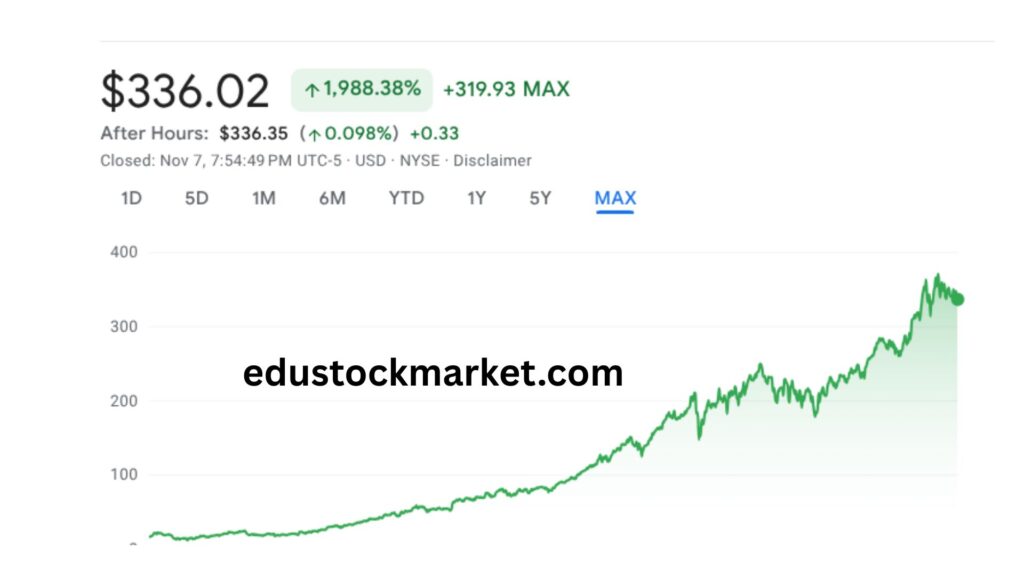
- Analysts’ near-term consensus (12-month) centers around roughly $380–$405 per share, implying mid-teens upside from mid-2025 levels — but estimates vary. MarketWatch+1
- Structural tailwinds (digital payments growth, value-added services, AI) support steady revenue and margin expansion to 2030; however, competition, regulatory pressures, and technology shifts (stablecoins/real-time rails) are real risks. Visa Corporate+1
- My bottom-line forecast range for visa stock price by year-end each year:
- 2025: $350–$410 (near-term consolidation and buybacks) Investopedia+1
- 2026: $380–$440 (resume growth, multiple expansion if macro stabilizes) StockAnalysis
- 2027–2028: $420–$520 (continued payments penetration + monetization) Mordor Intelligence
- 2029–2030: $480–$650 (bull case with strong global volume growth; bear case sees $350–$420). LiteFinance+1
These are ranges, not guaranteed numbers. Read on for the reasoning, assumptions, and risks.
Why Visa’s long-term thesis still holds Visa Share Price
- Network effects and scale. Visa’s platform connects issuers, acquirers, merchants, and consumers; scale makes it hard for newcomers to replace it across geographies. This supports high margins and recurring volume fees. s1.q4cdn.com
- Secular payments growth. Estimates for the global payments market show high single-digit to low-double-digit CAGR through 2030 as commerce digitalizes (cards → mobile wallets → online CX). Growth in cross-border e-commerce and B2B modernization expands addressable volume. Mordor Intelligence
- Value-added revenue streams. Beyond interchange routing fees, Visa grows through data & analytics, tokenization, value-added services, and partnerships (e.g., BNPL integrations, stablecoin rails experiments). These lift margins over time if monetized well. Visa Corporate+1
- Capital allocation discipline. Large buyback programs reduce float and support EPS growth even if top-line growth is steady rather than explosive. Visa announced meaningful buybacks in recent periods, which supports share price mechanically. Investopedia
Key inputs behind the 2025–2030 forecast
To forecast visa stock price we combine: revenue/TPV (total payment volume) growth assumptions, margin trends, share count trajectory (net of buybacks), and plausible valuation multiples. Visa Share Price
- TPV growth: assume mid-single digits (~6–10% CAGR) in developed markets and faster growth (10–15%+) in emerging markets. This blends to a blended growth profile that supports top-line growth roughly 8–10% early in the period, moderating later depending on macro. Mordor Intelligence
- Margin/monetization: steady or slightly expanding operating margins as V monetizes value-added services and keeps fixed-cost leverage.
- Share buybacks: continued repurchases (subject to capital allocation choices) shrink shares outstanding — a tailwind to EPS and the implied visa stock price. Recent programs signal willingness. Investopedia
- Valuation multiple (P/E / EV/EBITDA): Visa historically trades at a premium to the market due to predictability and margins. The forecast assumes a multiple range that can compress or expand with macro and rate sentiment; much of near-term price movement is multiple-driven.
Year-by-year view (narrative)
2025 — consolidation and normalizing multiples Visa Share Price
Outcomes: volatility around macro news, but earnings resilience. Buybacks and strong payments volume should support a price band of $350–$410 by year-end as investors digest growth vs. rate risks. Analyst 12-month targets in 2025 cluster around the high $300s to low $400s. MarketWatch+1
Visa Share Price Forecast 2026
If travel recovers further and cross-border spending rises, Visa benefits disproportionately. Expect $380–$440 assuming stable rates and continued TPV growth. This year is sensitive to merchant acceptance trends and any major regulatory shifts.
Visa Share Price Forecast 2027 2028
Adoption of digital wallets, real-time rails, and value-added services can accelerate revenue per transaction. In a constructive macro, Visa could reach $420–$520 by end-2028 under a base-to-bull scenario. If regulators or alternative rails (e.g., open banking or stablecoin rails) materially cut into fees, the lower end remains possible. Investopedia+1
Visa Share Price Forecast 2029 2030
By 2030, the payments market size and Visa’s monetization choices matter most. In a bullish scenario (strong global TPV, high monetization), $550–$650 is plausible; in a cautious/bear case (margin pressure, regulatory caps, or faster disintermediation), Visa could trade $350–$420. Forecasting precise 2030 numbers is inherently uncertain; the pathway depends on execution and external forces. FinancialContent+1
What could make the visa stock price beat the forecast?
- Faster-than-expected digital payments adoption in emerging markets.
- Successful new revenue streams (e.g., data services, value-added merchant products) that raise revenue per transaction.
- Large, accretive acquisitions or exclusive partnerships (market share gains).
- Significant buybacks coupled with margin expansion. s1.q4cdn.com
What could break the thesis (downside risks)
- Regulatory action limiting interchange fees or imposing stricter competition rules.
- Technology disruption: if merchants migrate to alternative rails (stablecoins, direct bank-to-bank rails) that bypass card networks more quickly than anticipated. Investopedia
- Macro shocks reducing consumer spending and TPV materially.
- Execution failures in monetizing non-transaction revenue streams.
Valuation sensitivity (simple view)
- If Visa grows revenue ~8% and EPS grows ~10% annually, and the multiple stays around today’s consensus (mid-to-high 20s P/E), then a mid-2020s target in the $400s is consistent with analyst models. If the multiple compresses (rates up or risk appetite down), the visa stock price could be well below that even with steady fundamentals. StockAnalysis+1
Practical advice for investors (direct)
- If you’re long-term and believe in digital payments: Visa is a core incumbent with a durable moat. Position sizing should reflect that even strong businesses face regulatory and tech risk.
- If you’re timing the market: watch TPV trends, cross-border volume, and analyst revisions — these drive sentiment. Also track Visa’s buyback cadence. Investopedia+1
- Use dollar-cost averaging rather than attempting to pick exact entry points — volatility from macro and regulatory headlines is common.
- Rebalance if your thesis changes: e.g., if meaningful regulatory caps occur or if Visa’s share of a new payments rail drops sharply.
Sources & why they matter (high-level)
- Analyst consensus & price targets (MarketWatch / Investing / StockAnalysis) — useful for market expectations and near-term targets. MarketWatch+1
- Company filings, investor day material — Visa’s own estimates of addressable market, strategic priorities, and buyback plans. s1.q4cdn.com
- Market research on global payments market (MordorIntelligence) — frames the macro growth envelope that supports Visa’s revenue assumptions. Mordor Intelligence
- Recent earnings reporting and news coverage (Investopedia, Barron’s) — captures concrete developments such as buybacks, AI and stablecoin commentary, and analyst moves. Investopedia+1
Frequently Asked Questions (FAQ)
Q: What single number should I expect for Visa at the end of 2030?
A: No single number is reliable. Reasonable model outputs range widely (roughly $480–$650 in bullish views, $350–$420 in conservative views) depending on TPV growth, monetization, buybacks, and multiples. Use ranges, not a point estimate. FinancialContent+1
Q: Is Visa a buy today for long-term investors?
A: If you accept the payments-network moat thesis and can tolerate regulatory/tech risk, Visa is a reasonable long-term holding. Analysts generally rate it “Buy/Strong Buy” with average 12-month targets in the high $300s–low $400s (as of late 2025). But match position size to your risk tolerance. Investing.com India+1
Q: How important are buybacks for the visa stock price?
A: Very. Buybacks lower outstanding shares and amplify EPS growth even if revenue growth is modest. Visa’s announced buyback programs are a direct support to share price, though execution and timing matter. Investopedia
Q: Will crypto/stablecoins kill Visa?
A: Unlikely in the near term. Stablecoins and new rails could erode some interchange economics over time, but Visa is investing in tokenization, stablecoin integrations, and value-added services. The threat is real but execution and regulation will determine the pace. Investopedia+1
Q: How should I watch Visa over the next 12 months?
A: Monitor TPV growth, processed transaction growth, buyback announcements, margin/monetization metrics, and any regulatory headlines about interchange or network pricing. Analyst revisions and consensus price target changes are also informative. Yahoo Finance+1
Closing (straight talk)
Visa’s long-term position in the payments stack is strong; the company benefits from secular shifts that should lift the visa stock price over time. That said, the path between 2025 and 2030 is not straight — multiples, macro, regulation, and technology choices will drive year-to-year outcomes. Use ranges, keep an eye on the few high-impact variables listed here, and size your position for both upside and downside.
If you’d like, I can:
- produce a spreadsheet model showing revenue/EPS/multiple scenarios and precise price outputs for each year 2025–2030, or
- write a shorter market update you could publish summarizing this forecast.